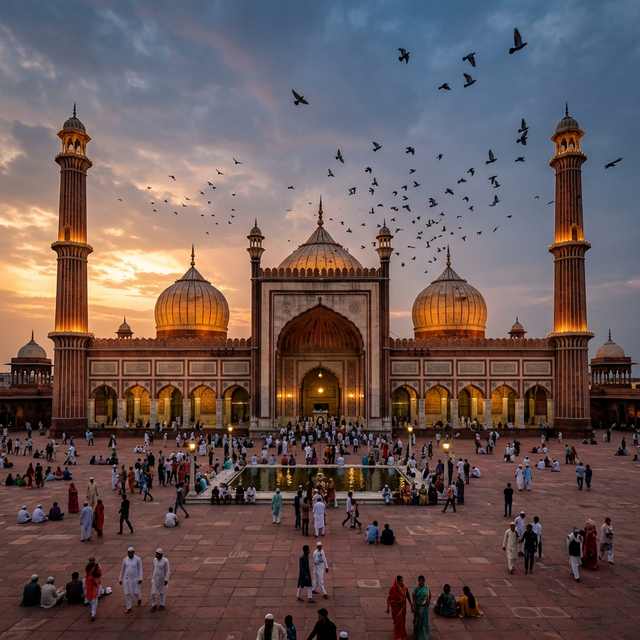
At the western terminus of Chandni Chowk, far from the imposing red walls of the Red Fort, sits a quiet sanctuary of devotion. Built in 1650 by Fatehpuri Begum, one of Emperor Shah Jahan’s wives, the Fatehpuri Masjid has stood witness to the tumultuous history of Delhi for nearly four centuries.
A History of Upheaval
Following the Indian Rebellion of 1857, the British confiscated the mosque and subsequently auctioned it off to a local Hindu merchant, Lala Chunnamal, for a sum of roughly Rs. 19,000. It wasn't until 1877 that the mosque was returned to the Muslim community, traded back by the government in exchange for four villages.
Architectural Elegance
The mosque is constructed from traditional red sandstone but is famously distinguished by its single, prominent white dome crowned with a green lotus finial. The plasterwork creates the illusion of white marble, adorned with distinctive longitudinal stripes.
The prayer hall features seven distinct arched openings, flanked by towering 24.5-meter-high minarets. Today, stepping inside its expansive, peaceful courtyard—complete with an ablution tank—provides an immediate, serene contrast to the intense hustle and aroma of the adjoining Khari Baoli spice market.